Find more of your liking

Monday, 6 July 2026

The overwhelmment of existence

Life has been a lot, and I would add lately till I realize it is not just so.

Life has been a lot for a 5-year-old, leaving granny, aunty, and grandpa, and moving to a hot, scorching land.

Life has been a lot for a 10-year-old learning and growing in languages unknown to her pedigree, where her skin colour is alien.

Life has been a lot for a 15-year-old trying to find a gender and a self and a future.

Life has been too much already for a 20-year-old unable to make her way up in capitalism, amidst her family's destitution.

Life has been nicer ,since, to a 25-year-old who is taking baby steps outside her mental misery and social class.

Life has been half a battle won for a 30-year-old, half a battle to win whilst facing extrapolated fears-she has lost so much; what will it take to win the rest?

She carries many scars, but deep and unhealed are the ones gained in the last 5 years, scars too deep for anyone and postfaced by overwhelming victory.

Carrying simultaneously the crowns of privilege and mutilations of disprivilege, what weighs heavier? Hard to weigh when both are proportionately overwhelming.

BV Aditi Prasad

Saturday, 20 November 2021

India's Forest Policy: A dilemma of development

 At COP21, India committed to increase its forest cover to 33 percent of total land area in order to create carbon sinks that would reduce carbon emissions. Currently 24.56% of the land area is under forest or tree cover. The National Mission for a Green India (GIM) is dedicated to achieve this target. At the COP26 summit, India declared its ambitious commitment to achieve Net Zero emissions by 2070. Surprisingly there is no mention of any attempt to utilize carbon sinks-India’s tropical forests to reach emission targets.

Dilution of forest legislation:

There has been a trend of increasingly confusing proposal for changes to India's forest legislation- confusing because of the blatant use of doublespeak.  While retaining the original essence of the old policies, there is an attempt to introduce contradicting edits. One of the first was the ominous proposal to amend the Indian Forest Act, 1927 that gave more power to the forest department authorities-even to use firearms. After vehement opposition, this proposal was dropped but the Ministry of Environment, Forest and Climate Change (MoEFCC) has again expressed intentions to amend the act. It aims to decriminalize minor violations of law, promote people participation and ease of doing business

The National Forest Policy, 1988 describes a lofty mandate of maintaining environmental balance for the sustenance of all life forms. Direct economic benefit was considered secondary. In the 2018 draft of a revised National forest policy the focus is less on forests and more on carbon storage related processes which means little to the wildlife and indigenous people inhabiting forests. We must remember that “green cover” is not synonymous to forest. A forest is a composite of biotic (including humans) and abiotic factors that evolve over thousands of years and it is essential to preserve this equilibrium. You may like trees around your houses but won’t be very happy with tigers staying there. Urban greening, social forestry and private afforestation programmes are definitely welcome but should not be included in the definition of forests as they cannot be inhabited by wild animals and indigenous tribes.

The draft National Forest Policy also emphasizes on the need to carefully examine any diversion of forest land for non-forest activities based on social and environmental costs and benefits. It further talks about regulating felling of trees on private holding. Yet the proposed amendments to Forest Rights Act (FRA), 1980 are an antithesis to proposed National Forest Policy, 2018. 

The amendments to FRA propose to exempt lands under seven categories from the purview of the Act in order to expediate developmental projects related to security, roads and railways, and forestry and tourism related activities. As per FRA, 1980 to carry out non-forest activities in the above mentioned situations, stakeholders needed to obtain permissions, and pay a fee or provide alternative land for afforestation. The amendments are proposed to ease and quicken time taken for developmental progress thereby reducing opportunity costs.

Yet, a complete exemption implies no regulation, no measure to ensure little or no effect of non-forest activities on wildlife or forest dwellers of sensitive areas. According to MoEFCC data, the FCA has been effective in preventing deforestation: Between 1951 and 1976, 1.6 lakh hectares of forest area was diverted every year for non-forest activities which reduced to 32,000 hectares between 1980 and 2011. Diluting this important legislation would erase the progress made till now. What is the percentage of currently forested land that might be diverted under these exemptions and how does it affect India’s goals for forest cover, carbon sequestration, tribal rights and wildlife protection? It would be irresponsible to proceed with the amendments without such estimations and projections. 

Are we on target to reach our forest conservation goals?

There is undue importance given to the role of forests in conservation of water. Water related issues in India such as drying up of rivers and depleting ground water are caused by dams, water pollution and over exploitation and it’s more prudent to address these issues.  Though protected forest areas are referred to as a network, there is no mention of the need to enhance connectivity amongst forest areas. India’s protected areas are disconnected with intervening large tracts of human dominated landscapes.

Another commonality in the different changes in forest related legislations is the attempt to reduce power of states and transfer to the Centre. Any shift in power should be towards the governing bodies at grassroots. It is high time India empowers the district and state level authorities to pass by laws as required for local situations.  

A holistic forest policy would aim at i) protecting existing forests, ii) improving forest quality and connectivity and iii) ensure forest dwellers have full access to their ancestral land. To preserving the existing forests requires keen scrutiny on part of the authorities. It is important to understand the opportunity costs of deforestation for economic benefits. Economic value of deforestation is low compared to its detrimental effect on agriculture, global climate and trophic structure of ecosystems. Monoplantations and forests degraded by invasive species do not function the same way as pristine forests and are expected to be less effective in attaining sustainability goals on a per area square basis. Discontinuous forests lead to habitat loss, loss of genetic diversity of biotic components and increased danger to human life from wildlife-animal conflicts. Lastly, it is important to remember that human communities inhabiting forest areas since centuries are a part of the definition of forests. They fall under the poorest fraction of India and protecting forests on their terms is essential for poverty alleviation in India.    

India need not stick to the colonial area goal of 1/3rd forest cover nor is it correct to cite the 'sustainability does not go with development' adage. A better goal would be to conserve 1/3rd of India's wild habitat which would include grasslands, coral reefs, marine and freshwater bodies , mangroves and mountains. India definitely needs to stick to sustainable development goals as the effects of climate change would be most severe for poor, developing countries. 

 References:

https://indianexpress.com/article/india/govt-proposes-changes-to-forest-conservation-act-7554520/

https://www.jstor.org/stable/2539228

http://environmentclearance.nic.in/writereaddata/OMs-2004-2021/263_OM_02_10_2021.pdf

https://india.mongabay.com/2019/01/indias-forest-cover-target-influenced-by-colonial-policies-rather-than-scientific-basis-says-study/

https://www.asb.cgiar.org/project/opportunity-costs-avoided-deforestation-sustainable-benefits

https://www.hindustantimes.com/ht-insight/climate-change/indias-commitments-to-increase-tree-and-forest-cover-101626849871744.html

https://track2training.com/2021/04/21/indias-crippling-tropical-forests-epitomize-carbon-sinks/

https://india.mongabay.com/2021/04/indian-government-makes-another-attempt-to-amend-the-indian-forest-act-1927/

https://moef.gov.in/wp-content/uploads/2021/04/MoEFCC-inviting-EOI-for-draft-amendments-to-IFA.pdf

http://www.indiaenvironmentportal.org.in/files/file/Draft%20National%20Forest%20Policy,%202018.pdf

https://moef.gov.in/wp-content/uploads/2021/04/MoEFCC-inviting-EOI-for-draft-amendments-to-IFA.pdf


Friday, 19 November 2021

Recombinant DNA: A Circumspection

 Recombinant DNA technology not only revolutionized scientific research but also triggered the birth of the private sector biotechnology industries. It involves combining genetic material from different organisms to obtain desirable phenotypes. This technology has opened numerous avenues in medicine, basic research and industry. It also gave rose to as many concerns.

Organisms thus modified could interact with non-modified, wild populations and bring about unpredictable changes risking environment and public health. The Asilomar Conference on Recombinant DNA held in 1975 brought scientists, lawyers and physicians together to establish guidelines and restrictions to be imposed on rDNA. It enlisted precautions regarding containment, good handling practices and restrictions on experimenting with infectious organisms to prevent any major accident.1

The science of rDNA continues to be applied in different contexts.

 rDNA Today:

At the time of the Asilomar conference, there was no practical application of rDNA. Today, rDNA is used in the production of high yield, high nutrition GM crops, in production of vaccines, hormones and medicines, bioremediation, environment friendly energy sources and gene therapy.2,3 All of these applications of rDNA have been controversial with safety concerns bringing the discussion into public domain.

The case of He Jiankui a researcher in Shenzhen, China using CRISPR on human embryos to provide immunity against HIV awakens us to the many undesirable results of such experiments.4 This necessitates us to reconsider the potential hazards in the 21st century and how it can be avoided. A revision of guidelines and precautions seems to be necessary. The following discussion aims to do the needful.

Medicine and gene therapy:

Drugs developed through rDNA should pass through several layers of scrutiny and testing before being prescribed. Testing the drugs on non-target systems can further help identify potential side effects.

Gene therapy must be strictly regulated as intergenic interactions are not well understood. The effect of any modification elsewhere in the body cannot be predicted. It should be particularly avoided at the embryonic stage. Germ line modifications can be inherited and might make containment difficult. It could introduce new diseases into the population, spring a demand for “designer babies” and could be used by anti-social elements in numerous ways.

Genetically Modified (GM) crops:

GM crops and foods need to undergo thorough evaluation before being brought into market. Genetic modification on one locus may bring changes in non target locus. These changes may include increased production of compounds which may be toxic to the consumer.

A very well known example of introduction of GM crops leading to ecological complications is that of the effect of loss of a weed called milkweed on numbers of Monarch butterflies. Producing GM pesticide resistant crops allowed farmers to use huge amounts of pesticide on weeds leading to a drastic decline in milkweed numbers which is the primary food source for Monarch butterflies.5 It is an example of how caution should always be exercised when bringing in changes in the environment. Such GM crops are responsible for the increase in use of herbicide by 527 million pounds in the U.S. over 16 years of their commercial use. This has stimulated the production of herbicide-resistant weeds and increased water pollution by runoff herbicides.

Thorough Environmental Impact Assessment is necessary before introducing GM crops into the environment. Research needs to be redirected in finding better solutions to food production than making pesticide resistant crops.

Containment:

Conventional farmers are exposed to the risk of their crops being contaminated by transgenic pollen drifting from the GM fields. Such spill over has happened in the US with Monsanto’s crops and a farmer was accused of growing GM crops without permits. This is a depiction of how GM crops have social effects apart from economic, health and environmental effects.7

Such containment issues exist in case of all GM organisms- from plants and bacteria to humans. Utmost prudence needs to be exercised when permitting rDNA experiments on any organism. Only after the research group or institution has demonstrated their ability to contain such organisms and have clarified their intent of use and extent of modifications should rDNA experiments be permitted.

Repercussions for not adhering to norms must be dire to discourage malpractices. This includes consequences for the research group, institute as well as the country. Misuse of rDNA technology has global implications and hence countries must closely monitor such research.

In conclusion, strict norms and constant regulation can avert and mitigate any disasters resulting from the use of rDNA technology.


References:

1.     Paul Berg, et al. (1975). Summary Statement of the Asilomar Conference on Recombinant DNA Molecules*. Proc. Nat. Acad. Sci., USA. (June) 72(6)1981-1984.

2.     Suliman Khan, Muhammad Wajid Ullah, Rabeea Siddique, et al., “Role of Recombinant DNA Technology to Improve Life,” International Journal of Genomics, vol. 2016, Article ID 2405954, 14 pages, 2016. https://doi.org/10.1155/2016/2405954.

3.     Charles R. Cantor. (2000). Biotechnology in the 21st century. TIBTECH (January) 18.

4.     https://www.theguardian.com/science/2018/nov/26/worlds-first-gene-edited-babies-created-in-china-claims-scientist

5.     https://actions.sumofus.org/a/monsanto-is-killing-the-monarchs

6.     https://en.wikipedia.org/wiki/Biocontainment_of_genetically_modified_organisms


Friday, 14 August 2020

I was 13

I was 13

I went out to walk

A man my dad's age

Stared hard

At my non-existant breasts. 

Every part of my body felt gross. 

What had I done? 

What had I worn? 

How had I looked? 

That I drew such attention! 

It took me 10 years to realize

The gross was in that man's head. 

I was 13.


I was 16.

I was at my first job. 

Every other person was way older than me. 

And they knew I was underage. 

Yet

A guy hit on me. 

Sneakily got my number, 

Tried to get me alone in a room. 

I was terrified of working-

Terrified of dealing with

A lifetime of such men. 

I was 16.


I was 19.

My male friend asked me out. 

I said no. 

I said I have a boyfriend. 

He felt I was just a goal

Who had a goalkeeper

But could, nevertheless, be scored. 

I was 19.


Until green and blue mornings

Dark skies and yellow lights,

Happy faces and content hearts.

Distant laughter and late night contemplation,

Slow sleep after lots of F.R.I.E.N.D.S.

A lullaby by Saki. Or Mark Twain.

Sometimes a moth. Seldom a cat. Lots of tiger.

The rarely used, very organized desk.

The very, very used blanket and beloved cushion.

The missing of Amma's smell and Anna's voice.

The green mornings. Tinged with blue.


                                                -Aditi Prasad


Written on one pleasant Parijata night, drunk on comfort and fairy lights.

Thursday, 1 August 2019

How life works!

I wrote this article as an assignment for a course "Culture of Scientific Research" where we discussed the events leading to the discovery of the structure of DNA and debated on the ethics behind Watson and Crick's actions. The assignment was to assume the role of one of the people involved in DNA research during the 1950's and write what they might have written. I decided to be Linus Pauling!


A double helix structure for the nucleic acid is now the accepted DNA structure. The nucleic acid is christened D.N.A.   I appreciate how James Watson and Francis Crick used ball and stick models to figure out the elusive structure. It is much similar to my methods and Crick most graciously declared the structure as a tribute to me. They were of course aided by the excellent photographs taken by Rosalind Franklin. I would have been much more pleased by these gentlemen if they had had the scientific courtesy of accrediting peers for their contribution. 


I myself was keenly interested in studying the structure of nucleic acid. My first interest in large molecules arose in 1930s while I was studying haemoglobin. Even since 1929, I wanted to learn how life works. Genes being a part of chromosomes was a new discovery then. Between the two components of chromosomes (nucleic acid and proteins), I felt proteins, having more complexity must be the unit of inheritance overseeing the growth of organisms. Robert Corey and I had studied the molecular structure of amino acids and protein subunits for almost two decades. In the spring of 1951, we published papers detailing protein structures at the molecular level most importantly that of alpha helix. X-ray diffraction was a newly discovered technique and was used widely to study many large molecules. 


Astbury and Bernal had published X-Ray data for numerous biomolecules including nucleic acid present in the chromosomes and certain glandular tissues, then called thymonucleic acid. Its sodium salt forms viscous solutions from which oriented preparations could be made that gave excellent x-ray fibre photographs. Though I had referred Astbury’s X-ray data for proteins and tried to fit it to a model (which I had failed to do), I had not put much effort into understanding the nucleic acid structure. It was not until the summer of 1951 that my interest shifted to nucleic acids. I heard about the work done on sodium thymonucleate by Dr. Maurice Wilkin’s laboratory at King’s College, London. But Wilkins, quite understandably was not willing to share the experimental data and wished to publish independently. Astbury published one more photograph of thymonucleic acid  in 1947. The strongest period along the fibre axis was at 3.34 Angstrom. The molecule had high density and the solid state was fibrous. Astbury proposed a structure where a column of nucleotides were piled up on each other. He also believed that each nucleotide in a nucleic acid is linked to its neighbours through phosphoric acid.


 In 1951, Edward Ronwin outlined a possible structure of DNA based on Astbury’s data. Ronwin proposed that the phosphate groups were present in the middle of the molecule and the large bases stick out to the sides.  This structure again sparked my interest. There were many inconsistencies in Rowin’s structure. His proposed structure would decompose rather rapidly in presence of water which seems to be abundant in DNA. I myself was contemplating a helical structure for nucleic acid which seemed logical for any molecule with repeating units. A helix with the nitrogen bases at the centre would be constrained sterically and hence phosphates in the centre and bases towards the outer side made more sense. Yet, I continued to work on protein structure which was in a very exciting stage then.

 
In the summer of 1952 at a meeting in France, I realized from the Hershey-Chase experiments that DNA, indeed contained the gene and I shifted my attention to it. I expected the structure of DNA to be much easier to eludicate as it was made of just four nucleotides as opposed to proteins made of 20 amino acids.  Subsequent papers from different research groups described different aspects of the bonding between the numerous groups in DNA. Linkages between atoms of nucleotides and nitrogen bases as well as sugar and phosphates were known. Electron micrographs by R.C.Williams seemed to support the helical model.  The meridional reflection in the X-Ray with spacing of 3.40 Angstrom indicated a unit consisting of three nucleotide residues. This could not be found in a single helix structure. Hence, we proposed a three stranded helix where each the three strands coiled around each other.  The biggest mistake I made was in putting phosphate groups having no net charge at the centre of the helix. I ignored the crucial fact that at physiological pH, the phosphate groups would not possess hydrogen atoms and hence there would be no hydrogen bonds to hold the structure together. Also so many negative charges could not be accommodated in the core of the molecule as they would all repel each other. The model also did not account for the formation of sodium salts of DNA as sodium ions could not be accommodated within the core. This model failed to obtain acceptance. I had sensed this and started to correct some of the mistakes. I still thought our proposed structure needed more empirical evidence to be proved right which would require a couple of years.


 Meanwhile Peter sent me an advanced manuscript by his collegues at the Cavendish which described a double helix D.N.A structure with phosphates towards the outer side and bases towards the inner side, paired according to Chargaff’s rules and held together by hydrogen bonds. I still hadn’t seen the photograph taken by Rosalind Franklin which aided Watson and Crick’s discovery and hence considered it prudent to withhold my judgement. In April 1953, I was at last able to have a look at the model of the double helix as well as the now famous photograph 51. Then, I realized, I was wrong and James and Watson, indeed had the right model. They are jubilant on winning their “race”!


In retrospect, I rushed towards finding the structure. Some more research on chemistry of purine and pyrimidines would have helped a lot in the same way that Chargaff’s rules helped Watson and Crick. As a parting note, I stress on the importance of this discovery. It will contribute immensely to the field of molecular genetics.


Linus Pauling


References:


1. Horace Freeland Judson(1979) The Eight Day of Creation.
2. Francis Crick(1988). What Mad Pursuit.
3. Watson, J. D. (1968). The Double Helix: A Personal Account of the Discovery of the Structure of DNA. 
4. W. T. Astbury. (1939) X-ray studies of the structure of compounds of biological interest. Annu. Rev. Biochem. University of Leeds 113-133

5. Linus Pauling and Robert B. Corey. (1952) A Proposed Structure for the Nucleic Acids. Proc. N. A. S. (39)


6. J. D. Watson and F. H. C. Crick. (1953) Molecular Structure of Nucleic Acids. Nature. Vol. 171


7. https://paulingblog.wordpress.com/2009/04/28/the-pauling-corey-structure-of-dna/

Acknowledgements:
The course instructors and teaching assistants for the idea and help in execution.


Friday, 5 April 2019

To the parent of a son


Okay.

I will stay at home at night.

I won’t drink.

I won’t party at clubs.

I won't wear short clothes.

I won’t talk and laugh openly in public.

I know it’s for my good. I will take care of me.

But what will you do for my good?

When will you tell your sons?

She’s not asking for it;

She’s not all breasts and vagina;

She’s not supposed to look thin or fair.

She’s not supposed to be whistled at,

Winked at or blown kisses at.

That

He is supposed to see her as an equal,

A living entity-a whole made of many parts.

That

"No" means exactly that!

Women don't have a separate language.

That

Perverts who objectify women

Are the ones “asking for”-

A slap on their face.

The day you teach him that-

Then- I will truly be safe.


Recently, I heard a crazy remark on the "Teach your sons not to rape" quote: What parents teach their sons to rape? 

Parents do no teach them to rape;NEITHER DO THEY TEACH THEM NOT TO RAPE. We need to impregnate our sons with the need to respect women, that eve teasing and rape is lowly. We need to spell that out. We need to teach the meaning of no and of a less known concept of "consesual sex". We need to make teaching this a cultural norm!

Thursday, 28 March 2019

Once, at dusk.

It was nearing dusk,but there was still good light. Arrowhead had just mesmerized one and all with her glamorous walk down a long dusty road before disappearing into the thickets. She seemed to have food on her mind. Twenty days ago her tiny,tiny cubs-just orange fur balls-had peeped out of green grass and left one and all in bouts of puppy love. All the Gypsys dispersed with this momentous sighting. We moved towards the nearest forest chowki to end the day around a warm oven with stories of the wild from the tongues of the forest guards . We might have traveled some 750 km when Arrowhead emerged from the bushes right behind us. I could have stretched my hand and patted her arrowed head. We waited, unable to fathom the mother's intended path and afraid to startle her by any movement. Soon it became evident that she wished to continue on the path right before us. Our gypsy was blocking her way.

She did nothing "wild" or "tigery".

She moved through the undergrowth and crossed a chain separating two zones. On the other side, she gracefully raised her tail and sprayed her fluid over some stones. Wordlessly, soundlessly and like a queen, she declared the place to be her own. We moved away from the area to avoid disturbing her again.

A day later, the zone was shut down to prevent any disturbance to Arrowhead and her kids housed in an ancient hunting palace that lay right at the end of the chained road.

Wednesday, 27 March 2019

I chose

I chose this.
I chose to be intoxicated:
With the lust of search,
With the process of curiosity,
With the rhythm of an experiment,
With the blinding beauty of an answer.
I chose to be possessed by questions:
Questions troubling my sleep,
Questions robbing my sleep,
Questions invading my dreams,
Questions giving rise to questions.
It's my ecstasy.
It's my euphoria.
It's what makes me alive.

Explaining to people why I actually like science and not ruining my life by "studying" constantly! 

NGS prep at Lab 3,National Center for Biological Sciences

Monday, 18 March 2019

THE FRUITFUL LIGHT


“I have no special talent. I am only passionately curious”, said Albert Einstein and these words of his are regarded as epitomic of scientific thought and motivation. Scientists has always been imagined as someone poring over books or into a microscope or staring deep into space. They are viewed as aloof creatures who are not interested in the day-to-day rigors of life. Less often is a scientist imagined to be tinkering with machines and trying to build something. This is surprising seeing that we live in an era where our lives have been influenced by science like never before. If a scientist is someone who is not concerned with material life and comfort how come science has led to such a materialistic and technology driven era? This itself is proof for how over the years science has transformed from a Gentleman’s hobby to a directed, applicative profession.
Even though science seems to have turned into a more fruit bearing activity, scientists still find curiosity as the driving force for their research. This brings us to the widely discussed question about what is the “better” method of scientific inquiry. That which is driven by curiosity called experiments of light or that which is driven by the requirement to fulfil a need called experiments of fruit.

Men of scientific repute have commented at length about both methods of inquiry. Flexner a strong advocate of experiments of light had commented,”...the less they (institutions) are deflected by considerations of immediacy of application, the more likely they are to contribute not only to human welfare but to the equally important satisfaction of intellectual interest”(1).

John Cornforth winner of the 1975 Chemistry Nobel, attributed his prize to ‘a lifelong curiosity about the shapes, and changes in shape, of entities that we shall never see; and a lifelong conviction that this curiosity will lead us closer to the truth of chemical processes, including the processes of life’(3). Cornforth is one of several Nobel Prize winners who have attributed their success in research to curiosity which is ironic seeing that Nobel prizes are mostly awarded to applicative research. Daniel Sarewitz, Professor of Science and Society in Arizona State University argues that technology and not curiosity has heralded most of the innovations in today’s era. He considers what Vannevar Bush- M.I.T. engineer who headed the United States World War II research, stated about scientific progress resulting from “the free play of free intellects, working on subjects of their own choice, in the manner dictated by their curiosity for exploration of the unknown” as a “beautiful lie” which has since then caused science to get “trapped in a self-destructive vortex.”(2) I found Robert Djikgraaf's explanation of how basic research supplements the knowledge required for applicative research which in turn spurs the need for more information and more basic research resulting in a cycle very convincing.(4)

Curiosity driven research is essential as with limited knowledge, humans cannot perceive the connections between different entities. Only on acquiring more knowledge does one get to know how different entities interact and can then use this knowledge to address problems in that field. The discovery of Taq polymerase is one example out of many of how a curiosity driven experiment- a “mere” study of thermophilic bacteria led to the development of a technique which has almost universal usage.
Applicative research is as essential as basic research. There is no use of knowledge if it cannot solve problems. Initially science was a hobby with rich men fiddling with science just out of curiosity and to while away time. Now, science is more of a profession with taxpayer’s money being used to pay scientists and fund research. It is inevitable that a common man will ask about the use of something his money is being used for. In today’s times when human health is endangered by numerous illnesses, agriculture is unable to feed all, wildlife is at high risk of extinction , non-renewable resources are at an all time low and countries prevent war by threatening each other with weapons, “useful” and “relevant” research is of utmost necessity. Yet, basic research should not be discouraged and must be funded sufficiently. Discontinuing curiosity driven research and funding only translational research will be equal to pushing down science into Sarewitz’s “self-destructive vortex”.

Scientists must carry out experiments of fruit but should be unbiased enough to accept fruits different from what they expected and also to identify those fruits which were unexpected. Serendipity in science has given rise to many objects of utility from the microwave to the pacemaker.(5) Scientists should be conscious of not ignoring such results in the race to publish translational research.

How research funding should be divided between basic and translational research is something to think about. How applicative research could lead to unproductive results is visible in the results of breast cancer research funded by Department of Defense of the USA.(2) Billions of dollars were utilized with no constructive results. Margaret Thatcher is the first name which comes up in policy making for research funding. Having herself worked in the field of Science, Thatcher emphasized on the importance of basic research. She argued that the rewards of basic research could not be judged immediately and hence it is difficult to make a decision on distribution of Government funding.
She recommended providing support to “those teams, however small, which can demonstrate the intellectual flair and leadership which is driven by intense curiosity and dedication”(3). This curiosity could be directed towards applicative research, not necessarily basic research. Curiosity driven research would prevent science from being biased in a singular direction.
Thus, curiosity should be maintained as the driving force for research –even translational research. Experiments of light should lead one to experiments of fruit.


References:

1. The Usefulness Of Useless Knowledge by Abraham Flexner. Harpers Issue 17. June/November,1939.
2. Saving Science by Daniel Sarewitz. The New Atlantis. Spring/Summer 2016.
3. The Curious History of Curiosity-Driven Research By Jon Agar doi:10.1098/rsnr.2017.0034
4. https://blogs.scientificamerican.com/guest-blog/knowledge-is-a-kind-of-infrastructure/5. https://www.sciencealert.com/these-eighteen-accidental-scientific-discoveries-changed-the-world?perpetual=yes&limitstart=1

Sunday, 5 August 2018

New city, new friend

My body actually runs on caffeine and hence it is the first thing that has to be put in my system in the morning though it is said to be not the right way to break a fast. On shifting to  a hostel for my PhD, I found myself on the very first morning coffeeless, key-less and helpless. All efforts to locate the lost room key were in vain without the mandatory concentration of caffeine in my blood stream and hence, it was decided to fix this deficiency first. I found myself before the pond sipping the coffee which began to clear my head which resulted in me able to note the presence of an individual whom I hold in high esteem. I caught sight of a Brahminy kite right in the midst of a tree right at the center of a small island which in turn was in the middle of the pond and was going through it's ritual morning preening and cleaning. I had been mesmerized by another of her species a couple of years ago on the sea coast of Okha and was jubilant on having received this surprise darshan by the bird considered to be the present day representation of Garuda. She held her white head high and white shoulders broad above her chestnut body and struck an awe inspiring pose. I had not expected to see her so inside the city as she is named in Latin as Haliastur ( Sea+hawk) and my knowledge was limited to her habitation of sea coasts only. It turns out she lives near inland wetlands too.  She gave me company through out my cup of coffee and when I came back an hour later to her - caffeinated, bunch of the lost keys back in my pack and hopeful of having my breakfast with her, she welcomed me and joined me by diving marvelously and picking out a fish of her choice which she feasted on. When I came back with my lunch, she was accompanied with  a friend - on what business remained unknown to me as they chose to go deeper into the canopy which of course suggests quite a lot. I am very happy with my first feathery grad school friend and hope this alliance lasts. Throw out fish food waste, don't be too clean so that my friend who loves eating dead animals may get her stomach full.

A Brahminy kite (Haliaster indus) clicked in North India by Hareendra Baraiya

Happy friendships day!

Monday, 16 July 2018

PARALLEL WORLDS

On June 26th, I took a train from Hyderabad in Telangana, India where my cousins live to Vadodara in Gujarat,India where my parents live. On the way, I stopped first at Highbury in 17th century England to listen to an interesting account of a certain Emma Woodhouse and her youthful misadventures from none other than the esteemed Jane Austen. The next day ,still on the train, I stopped at 221B, Baker Street and had a little adventure with Mr.Sherlock Holmes (a completely platonic sort of adventure). I got off at Vadodara noon that day. That evening, I traveled to 18th century Bengal to be enraptured by compelling narratives about Bengali lives by the Tagore himself. My next adventure was in space! I spent a one and half hour of breath stopping free falls and jumps and walks through space alongside mission specialist Dr.Ryan Stone from NASA trying to survive a catastrophic accident. The next day's trip to the US of A right in the middle of the Roaring Twenties was Shakespearean(If that's not a word, I just invented it)-fun,romantic and ending in tragedy. I was left grieving the apathy and selfishness of the rich as I watched  Mr. Jay Gatsby try to woo his sweetheart during the Roaring Twenties and his great efforts to rise to her "standards".The very next day I was fortunate visit Malgudi where I learnt lessons about humbleness, dangers of greediness and necessity of proper upbringing of children from the life of a Financial Expert. Then there was this very disgusting and eye-opening acquaintance with a driver in 21st century India who called himself The White Tiger and went on to become a hardened criminal and a successful entrepreneur. The succeeding I went to Pheonicia in 870 B.C. with Paulo Coelho to be a spectator of a Biblical event. Next, migrated to post World War II USA. Francis Ford Coppola narrated a most captivating tale of one of my and many others's most favorite Don from a small village in Italy called Corleone. All this on top of the customary visit I pay to my F.R.I.E.N.D.S at Central Perk,New York. I next intend to embark on a journey to Saurashtra,Gujarat,India guided by Jhaverchand Meghani.

And they see Time Travel is not real? That there are no evidences for Parallel Universes ? Poof!

I would tell them about the time I spent learning magic for 7 years at a school in Scotland.


Saturday, 14 July 2018

In the Quest of a Nightjar

What got this fervor onto me, I remember not; what set me crazy after this, I know not: but I had to see nightjar in the day, in the heat of the day and that too without disturbing it. Usually, it so happens, as you go about in dry deciduous forests or through thorny bushes, unaware of the presence of this bird, suddenly a little far away something flies up from the ground and away and you then realize-that: was the elusive nightjar which was as deceptive as ever. But I don’t want to see it that way. My eyes should discover it when it is sitting steady: This was the craze that set over me in the summer of 2015.

For those who don’t know about the nightjar: it’s a most wonderful bird commonly known in my homeland Gujarat as Dashrathiyu. In the darkness following the sunset it starts declaring its presence with a chak chak chakrr call. When walking along at night, if you come across a pair of red eyes floating mid air, that, is your nightjar. This bird, owning a length of 24 centimeter, is found in almost the entire state of Gujarat. Nature’s real marvel lies in this bird’s colours. Accustomed to sit on the ground and lower branches of trees, the colours of this bird merges so well with the background that it can’t be spotted very easily. Coloured grey and dusty, the nightjar owns a golden neck and collar and a white patch on the sides of its neck. Its flat head and white ended tail immediately identifies it. Evolutionary pressures have endowed it with a wide buccal cavity which enables it to catch insects on flight and the bristles around its beak aid in holding on to the insects. What’s bizarre is that this bird doesn’t make a nest at all. Like lapwings, it clears some part on the ground where it lays 2-3 creamish pink eggs.

Now, coming back to me. Following completion of my graduation, when admissions for postgraduate programs were still underway, I used to wander about in my village, observing birds. I had seen nightjars before in my village but in the evening. I had not seen them sitting stable in their day time abodes. One evening it occurred to me that so many of these were visible at dusk and not a single could be seen in the day. This thought troubled me and I decided to find its day time abode.

Having decided so, I left home with a bag on my shoulders and ardor in my heart and a pair of binoculars and a field guide for company. It was a scorching summer and this bird breeds between February and September. So the probability of finding it at this time of the year was pretty high. Reaching the outskirts of the village, there were thickets of acacia as far as eyes could see. I moved head looking everywhere with a sharp, alert eye. Sometimes a dove or a bulbul would peek out, a francolin or a lark would lurk about but the nightjar remained as deceitful as ever. Walking along I sifted through borders of two more villages, but there was no sign of the nightjar. That does not mean it was not there. Just that my untrained eyes were still learning and hence had not spotted it. That is nature’s scheme of working. Every bird and animal is endowed with such colours as to keep it hidden in its abode. Thus, it is hidden from predators. But I was no predator! Why would it not show itself to me? But nature does not discriminate and I could not catch sight of my quarry. In one day, I scoured the borders of four villages to no avail. This continued for a week. I guess it was my mistake: I had no proper acquaintance with this kind of search but hoping to learn along, I kept looking. All alone with only the borrowed binoculars and a rucksack with a field guide and bottle of water to keep company. Roaming around in the heat all day the straps of my bag left marks on my back and shoulders. For a fortnight, having to work on my farm, my quest got sidetracked. When I started again, I had a ten year old boy-the son of the owner of the neighboring farm-for company. The boy was curious to know where I go and what I did. We went through the same landscape. We were passing by the bottom of a hill, with the boy walking ahead of me in his own rhythm. I was lagging behind making observations. Suddenly something flew right next to the boy. To where it flew, he didn’t see. I felt it should be a nightjar, but could not find it. My patience was being tested. But after having looked this long, I was now adamant to see it. After some two to four days, I returned to the same spot. I examined every rock at the bottom of the hill. Doing so, my eyes fell on the rocks surrounding the small check dams built to collect rain water and Eureka! Sitting there in the shadows of one of the rocks was a nightjar. With its eyes half closed and peaceful stance it seemed to be worshipping the Lord and seeing it so was soothing to my eyes. I was, at last, successful in seeing a nightjar after all these days of effort. In those days I used to use a Karbonn phone whose camera was not very good. I tried to take a photograph but the bird sitting almost 15 meters away could not be captured in the picture. But I wanted to take a picture after having had spent so much time after it. Then I got an idea to keep the lens of the camera in the eyepiece of the binoculars and take the photo but that again was very difficult. If the binoculars moved even a little bit, the bird was lost from the screen. And when it was stable, the camera would not focus. At last, I took a video instead with the help of the binoculars. For this video of 30 seconds, I roamed for 20 days in scorching heat. But even today, the joy I feel on seeing that video is greater than any HD photo taken with my Nikon P900 camera.


My good friend Hareendra Baraiya, a wildlife biologist writes in Gujarati a blog called Blue Feather. He has very kindly given me the honour of translating one of his blogs. Please find the link to my first piece of translation on his blog as well as the original blog in Gujarati.
http://hareendra3994.blogspot.com/

Tuesday, 8 March 2016

ON WOMEN'S DAY...

I am that sort of woman who generally favours the male sex for their nature,generosity,friendship,masti...in short i am quite pro-male.Then comes along women's day and there's this surge of pride within me for being a woman and then do i realise how proud a woman i am.

But why?

May be because i have seen so many women about me who have exhibited extraordinary strength and courage to prove their mettle in a male centric society.The aura about successful women sends waves of admiration within me.The cold-bloodedeness of an ambitious woman can't be matched by men.But this takes so much of a woman that very few of us give it free way.Women are great multi-taskers-take any woman.Endocrinologists should definitely study the role of estrogen in simultaneously stimulating different parts of the brain.

But mainly because  i would not want to be anything  other than this..a woman-the embodiment of beauty.Women can talk beautiful,web in people with their soothing voices and articulate words interspersed with winning smiles.Women think beautiful.I dont need to give an example of a woman thinker.All woman can think beautiful-be it beautifully ugly or beautifully beautiful.And when i say embodiment of beauty,i mean the beauty of our forms.The beauty in diversity of women's bodies is awesome.I may wail about having to comb my long tresses or how i need to take care of my dressing.But i won't deny the joy in shopping for all tiny tidbits-some bold,some pretty.

There is by doubt that women can push boundaries in whichever field they choose.A mental stimulus contributes more in achievement than physical body.It is definitely extremely admirable of women who pioneer efforts in domains alien to women because they have to fight psychological and societal barriers apart from the usual impediments towards success.But since society also puts various plugs on women's freedom and consequently happiness,if you can't do something extraordinary,you should start by doing nothing too ordinary or callosuly typical of feminine gender and do what they do best: spread love and compassion.Women need to be loved.But you can't get all that love from anybody. So here comes the cliché: love yourself.

Whenever i pause before the mirror longer than to just check my hair,i can't help but notice the way the kohl brightens the brown of my eyes,of the sensuality that red lipstick bestows to my lips,of how my hair silhouttes the curves of my face and then comes the smile first sending in waves of creamy lines into the cheeks ,lightening up my eyes,splitting my complexion into multiple shades of dusky,pulling back my lips and suddenly i notice the increase in the light about me..a million photons bursting into the air about making everything it touches...beautiful.Every woman's luminous smile brings forth a poem in my heart... 

A woman has variety and variety is the spice of life.Hence,the world without women would be a much more boring place.Seriously,like every major event in any yug,century...centers around a woman..Sita,Draupadi,Helen of Troy..women take away the monotony from lives.We are drama.In real life.And you like it or not;you certainly need it.

So I have not scaled mountains or dived from aeroplanes but i travel by city bus  service and in a country like india that is quite an adventure and accomplishment.Every woman,thus,has a reason to love herself.You just have to find it.And as Chetan Bhagat advised women in his last year's women's day article in Times of India,don't try to get an A+ in everything you do..sometimes its ok if you get an A or B.Be what you are: a poem yourself...

Happy women's day..


Tuesday, 29 December 2015

CHAOS

Dear mom,

I really hate myself when you scold me for making the house as dirty as possible.I can really imagine how painful it would have become for you to see a trail of inorder spreading away in my wake that you-my sweet little mother has to speak spiteful words for your own brilliant little daughter.

I wasn't like this remember?When you used to proudly praise before the neighbours about how clean I used to maintain the house?When I would not allow even you to do all the cleaning work and took on the whole house scrubbing it clean and leave it shining cleverly leaving a couple of nooks which I knew were frequented by lizards?When looking at more than usual spic-n-span house neighbours would immediately know Aditi was at work?When the cleaning frenzy reached such heights that I would gather all utensils dirty or not and scrub it till it shined like a diamond?(seriously) And when old women seeing the shiddat with which I worked proclaimed you to be blessed?

You might wonder where that cleanliness freak, ordered Aditi went?

Well she discovered that cleanliness is overrated.I still hate the sticky kind of uncleanliness.But i love clothes strewn across my bed.It helps me sleep better.The clothes about me,embracing me,soothing me to sleep.I love books stacked upon every empty surface.There's not a better decoration.And it makes finding things easier!!You loose things anyhow and in finding things through a neat,ordered stack,you damage the order in it and its traumatic,believe me,destroying the order you set up with your own hands.And then there's disorder-you push aside things pick up what you want and get done with it.

I will tell what's with the books.You have very faithfully partitioned your cupboard to have physics,chemistry,biology,time pass books and notebooks in different sections.Then the Biology book mentions the use of NMR to study cells.I can google NMR.But google does not explain magnetic resonance as well as my physics textbook and next thing you know you are digging into years of books looking for the elusive textbook.Then you realize it has a chemical aspect to it and out comes the laptop to refer to a chemistry textbook pdf copy.Then you remember an article on magnetic equipments several years ago in safari and you pull out the heavy kitbag in the store room containing centuries old science magazines and knock out a few utensils in the process bruising your knee badly but then you have the magazines and the next thing you know your room is strewn with magazines your hungry mind wolfing down as much as it can.

Also it improves your athletic abilities-jumping over obstructions,bending about in your chair at wierd angles to get what you want?What's a better exercise?So dont corelate my untidiness with my laziness.

Okay I know I dress untidily too.I look like a drug addict at home and am just 20% better dressing for college.But again I like that.You wear good fashionable clothes and you have to take care of your clothes rather than the other way round.And more horrible then that is that people notice you.And that's the last thing I want-people look at you and by mistake you look at them,next thing you know they are talking to you and you are forced to have a very painful conversation with a human being.

So that's it my darling momma. That's why I m sitting here writing this to you - surrounded by a half empty chocolate box,wrapper and a half licked chocolate wrapper(oh ya i am so clean I lick up to the last bit chocolate and ice cream wrappers as well as plates and utensils sometimes(the last part is exaggeration,honestly)),with my teeth full of bacteria for having eaten so much chocolate,my hair untidy,the stack of newspapers I have been wanting to read in-depth and revise since a week piled up beside me and slowly yellowing- only because I do feel bad about myself but am just aadat se majboor...

Yours lovingly,

Aditi

:)


The beauty of chaos

Saturday, 7 November 2015

BROWN BREW

We South Indians abide by our morning coffee.Not just some coffee-very particularly filter coffee:frothy,foamy,brown,strong,slightly bitter with a sweet after-taste.

Words arent enough to describe our relish for coffee dear coffee.When a guest arrives he is offered a glass of coffee even before water.Not a cup of coffee,George m'boy,a glass of coffee.A small stainless steel glass placed in a small stainless steel cup.Let the Chinese keep all their porcelein,we will mine out all the iron from Kudremukha to quench our thirst for stainless steel flavoured frothy,foamy,brown,strong,slightly bitter with a sweet after-taste coffee.

Stainless steel flavoured frothy,foamy,brown,strong,slightly bitter with a sweet after-taste coffee wakes us from our nocturnal slumber.A morning woken up to the chocolatey smell pervading through the house is a morning well woken up to.The aroma sneaks in through the nostrils,somehow reaches the medulla oblongata and stimulates it to escalate my need for the beverage to such an extent that all my morninng ablutions are carried out quickly and even during my prayers i can do nothing but thank god for bestowing mankind with coffee and making the world bearable.Then as i reach out for my coffee i can't but feel a strong surge of love for my mummy dear for making such excellent coffee.Every south indian woman every morning boils water and pours it into a coffee powder containing filter- a quintessential of every south indian household-and  leaves it for a while to trickle down through the tiny holes into the lower container.Till then she washes the front yard and decorates it with white rangoli.By then the filtrate called the decoction is collected in the lower container which is mixed with milk and sugar,boiled and poured into a glass from quite a distance so as to produce the necessary foam at the top.

The sugary,chocolatey liquid steaming hot is best consumed steaming hot.The taste of this coffee on a blistered tongue is unrivalled.It travels down your esophagus,soothing and clearing your throat and reaches your stomach where it makes a smooth landing filling that muscular sack much better than you would expect of a liquid.Even your tummy dear quivers with the joy of containing such a heavenly fluid!!!

Also our night slumber is brought about by stainless steel flavoured frothy,foamy,brown,strong,slightly bitter with a sweet after-taste coffee.Caffeine stimulates you?Makes you feel awake?Bull shit!!Just see us sleep after a glass of hot filter coffee.

Other than this,any hour of the day is coffee hour.Feeling bored,drink coffee.Woke from siesta,drink coffee.Lights out,nothing to do-drink coffee.Headache?Drink coffee.Any season is coffee season:coffee in rains accompanied with bombai bonda-totally scrumptious.Coffee in winter with a novel,a rug over your legs and roasted kaju:out of this world.Coffee in summer out in the balcony on the swing:delightful.Non-south indians have a misconception that we are obsessed with idli-dosa and people are like,"Din me kitne baar idli-dosa khate ho?"

Ask that for coffee,people.That's more sensible.Those who have tasted mere ghar ki coffee cant stop raving about it.This same coffee is sold in the market at 90 rs per cup!!!The experience of coffee at my home is priceless ;)

Just Google it.You would get a lot about the health benefits of coffee which i would not bore you with.Also the residue in the coffee filter and the stale decoction are not wasted:they are extremely good moisturisers which are used to wash the hair and scrubbed onto the skin leaving you with lustrous black hair and radiant skin.

One in your lifetime do taste this coffee.Maybe in a small canteen amidst the Western Ghats surrounded by virgin forests interspersed with coffee plantations.Or at a small cafe somewhere in Bengaluru with the rain pouring.Or badger your South Indian friend till they invite you over for coffee. ;) :)

But taste you should. ;) (y)


Filter Coffe as served in CTR Bangalore.

Friday, 6 November 2015

ME AND MY LOVE AFFAIR

I am a lovely person and I admit I have had numerous love affairs.Many scandalous,numerous fleeting and a couple long-standing ones.

Now come,come.Given all your fertile imaginations out there it makes it necessary for me to mention that all these affairs are not with humans.No sir, not a single affair with a human.

My first and most lasting love affair has been and continues with:books.

Books of all shapes,sizes,colours,genres and smells.When i was a toddler,my momma used to bring those thin books with huge colourful pictures depicting the ideal daily routine and with captions in Kannada script.She would read out to me and i would repeat and this continued till a time when i had all the captions of the respective pictures by heart.A funny incident that is well reminisced  in family circles is  when i, picking up a book sat down studiously before my uncle and began reciting the captions as though reading a book and my bewildered uncle overwhelmed to see his 3 year old niece deciphering the curled-as-jalebi Kannada letters brought the entire household into the hall only to find my mother bend over with uncontrollable,unending, speechless laughter at how convincingly studious her daughter can appear. 

That initial acquaintance with books i really enjoyed.And i didn't want it to end.So as i grew up and learned to read i developed a voracious appetite for reading.Lying down,sitting up,eating,watching tv,I had to read:be it individual letters,letters strung together to form words or words arrayed to form sentences or sentences woven together to form text-I HAD TO READ IT.Be it in books,on t-shirts,on walls,posters,products-written words make sense and i had to comprehend it.

But the joy of reading words out of books is undoubtably unmatched.The feel of the book on your hands,the rustle of its pages in your ear,the aroma of the pages wrapping around you and the words resounding in your head:all of this is certainly unique to reading books.I have tried reading soft copies but the experience is nowhere as thrilling.

Beginning with my first novel-an abridged version of Iliad and Odyssey- at the age of 7,there was no looking back.I gobbled up Enid Blyton,gulped in Ruskin Bond,drunk in Rudyard Kipling,crammed in J.K.Rowling,guzzled down Mario Puzo and devoured A.C.Doyle.

To prove the ingenuity of my feelings for books,I can well describe to you the three stages i went through falling in love:

1.Dunno what drew me to books but there definitely was attraction-sizzling chemistry.I would always be aware of its presence if a book was about me,stealing glances and studying in those stolen glances all that i could of its appearance.It would linger in my memory,every breath i took reminding me i have still to read it.

2.When i would at last get my hands on the book....i could just not keep my hands off it. Ishhh...the way it fills my mind,numbs me to the world,keeps me to it-all to it and the way i cant stay away from it till i have read it COMPLETELY like in COMPLETELY ...haiii

Promise: never has a guy succeded in doing this to me :P :D

3.And once i am done reading i cant but keep thinking of the book,the characters,the events and fantasize about what i would be doing if i were a part of the plot.I wish to read it again,go over all my favourite parts.It then becomes a part of a sweet memory which when remembered brings a smile to my lips.

And yeah this one IS a scandalous affair.You have No idea how much my family opposed my involvement with books.But kon samjhaye...pyaar andha hota hai... ;) And thats exactly what their argument was:you will go blind reading at this rate!!!

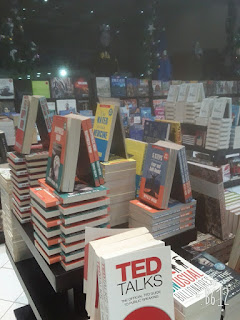
Crossword at Alkapuri,Vadodara

I knew my books which have always been a reliable companion to me throughout my life would bring out a solution to my weakening eyesight and sure enough I stumbled across yoga and naturopathy books which helped me stabilize my aankhon ka number.

Now my liaison with books will be incomplete without mentioning some of the highs.The first high lasted years long:my fling with the Harry Potter series. Like every other Potter maniac i did believe in the existence of a magical world till a certain age and used to keep looking over my shoulder at the window expecting an owl to bring me my letter of admission to Hogwarts.

Then i read Mario Puzo with his slick Italian dons, gun laden Mafia and love i did reading those books.

Now i have fallen for the writings of two beautiful women: Jhumpa Lahiri and Anita Nair.Another woman to reckon with is Agatha Christie.The neatness with which she writes crime stories is unparalleled.To know more about my appreciation of their works click here.

I am still waiting to read numerous other books,to relish a dip into diverse minds and lead several parallel lives in my mind.

For the record my other flings include dance,acting, painting, etc.

One of my more recent ones and a rather 'serious' love is my passion for wildlife. This love for animals was within me but has blossomed over the last few years and now i combine it with my passion for writing and poems.

So i end this with the hope that i am no longer bombarded with questions regarding my love life-all secrets have been revealed today people...there is nothing more to hide;)

These are close to my heart

ME AND MY LOVE AFFAIR

I am a lovely person and I admit I have had numerous love affairs.Many scandalous,numerous fleeting and a couple long-standing ones. Now...

People liked these :p

Followers